Science & Education guide
What is vibroacoustic therapy?
Vibroacoustic therapy delivers low-frequency sound vibration directly to the body, usually alongside music. You hear the music and feel the vibration. This guide explains how it works, what the research reports, and what it does not yet show.
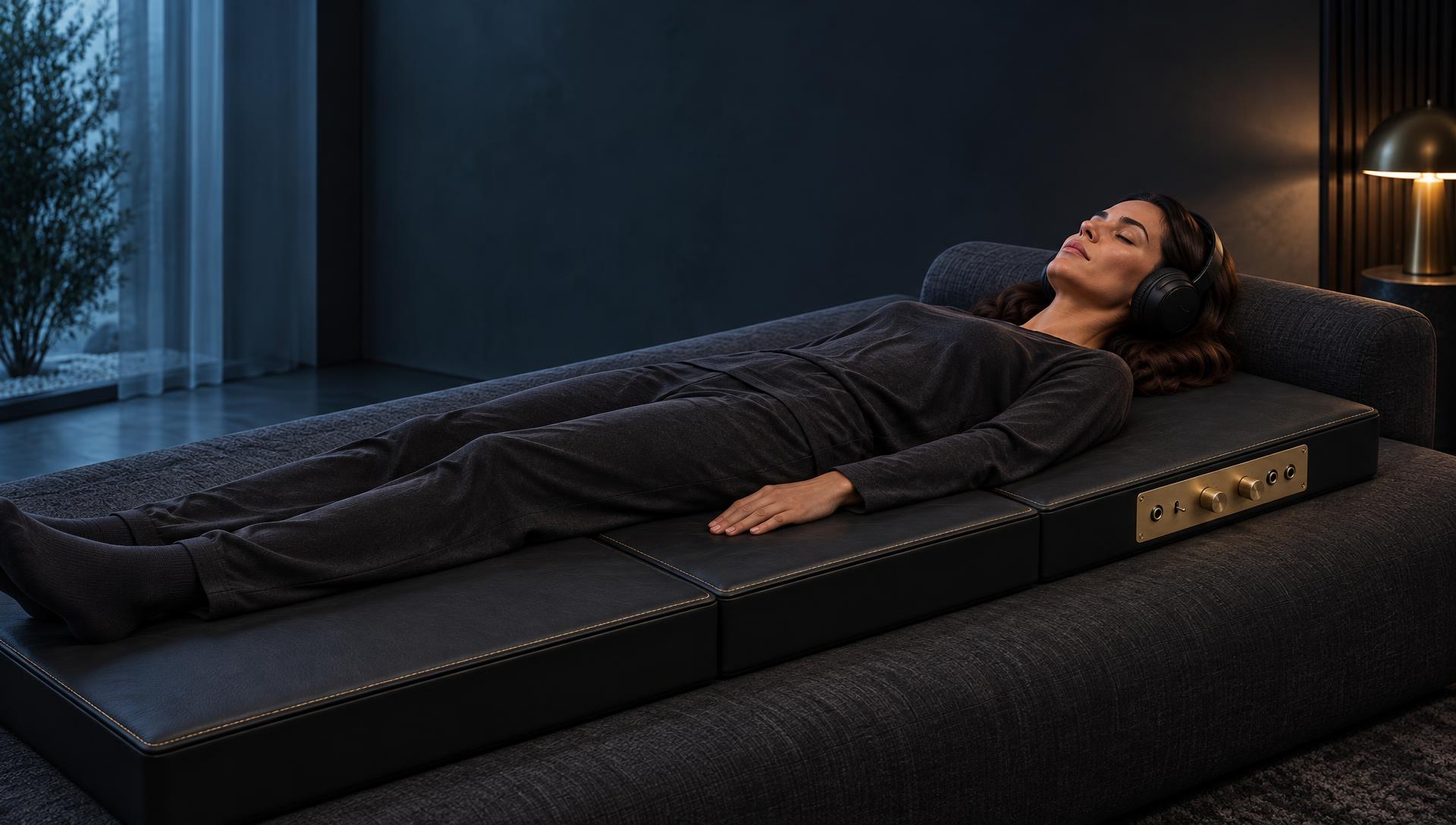
Where it comes from
Vibroacoustic therapy was developed by Olav Skille and Petri Lehikoinen. It uses low-frequency sound, typically in the 20 to 100 Hz range, played through transducers built into a mat, bed or chair.
Sinusoidal tones, most often around 40 Hz, are a common choice. The vibration travels through contact with the body rather than only through the ears.
How contact-delivered vibration works
Vibration stimulates deep-tissue receptors such as Pacinian corpuscles, which respond to pressure and vibration.
Researchers propose this input can reduce muscle tone and dampen pain signaling through spinal gate mechanisms. These are proposed mechanisms. They describe how vibration may act, not a guaranteed result for any individual.
What the research reports
A randomized study of 68 children with juvenile arthritis reported lower disease activity, anxiety and fatigue with vibroacoustic therapy.
A pilot randomized controlled trial examined low-frequency sound vibration and acute stress.
A blinded 2025 study found low-frequency vibration raised heart rate variability, a marker of the rest-and-recover system, 30 minutes after a session.
What a session is like
In clinical practice, vibroacoustic therapy is described as a receptive form of music therapy. A person lies on a specially designed bed, mat or chair while pulsed, low-frequency sinusoidal sound plays alongside music.
Practitioners treat it as a mind-body approach: they work with both what the body feels and what the person experiences emotionally, and use assessment, a planned session and follow-up rather than vibration alone.
How it differs from a sound bath or headphones
A sound bath and headphone listening reach you mainly through hearing. Vibroacoustic therapy adds a second channel: vibration delivered through contact, so the sound is felt across the body as well as heard.
That is why Biotune programs work on headphones and go deeper on a mat. Headphones carry the music and alternating left-right sound. A mat adds the felt BodyWaves.
Who should check first
Published reviews do not agree on a single list of contraindications. If you are pregnant, have a pacemaker or other implant, a clotting condition, epilepsy, a recent injury or surgery, or any ongoing medical condition, ask a clinician before trying contact vibration.
Limitations and open questions
Many studies are small, use different devices and frequencies, and run for short periods. Results from one group or condition may not apply to others.
Vibroacoustic therapy is not a substitute for medical care. Speak with a qualified professional before using it for a health condition, and stop if a session is uncomfortable.
How Biotune uses it
Biotune BodyWaves apply this principle: purpose-created low frequencies delivered through a vibroacoustic mat, paired with music. Programs work on headphones and go deeper on a mat. Biotune does not claim to treat or cure any condition.
Common questions
Is vibroacoustic therapy the same as feeling loud bass?
No. It uses controlled low-frequency tones, often around 40 Hz, delivered through transducers in contact with the body at comfortable levels, rather than loud speakers in a room.
Do I need a mat to use Biotune?
No. Biotune programs work on headphones. A vibroacoustic mat adds the felt BodyWaves layer.
Is vibroacoustic therapy a medical treatment?
Some studies have tested it in clinical settings, but results are early and vary by condition. Biotune is a wellness experience and does not treat, cure or diagnose any condition.
Sources
- Hauser, Besson et al., 2025. Heart rate variability response to low-frequency sound vibration
- Kantor et al., 2022. Low-frequency sound vibration and acute stress: pilot RCT
- Ailioaie et al., 2011. Vibroacoustic therapy in juvenile arthritis (PDF)
- Punkanen & Ala-Ruona, 2012. Contemporary vibroacoustic therapy: clinical practice, research and training (Music and Medicine)