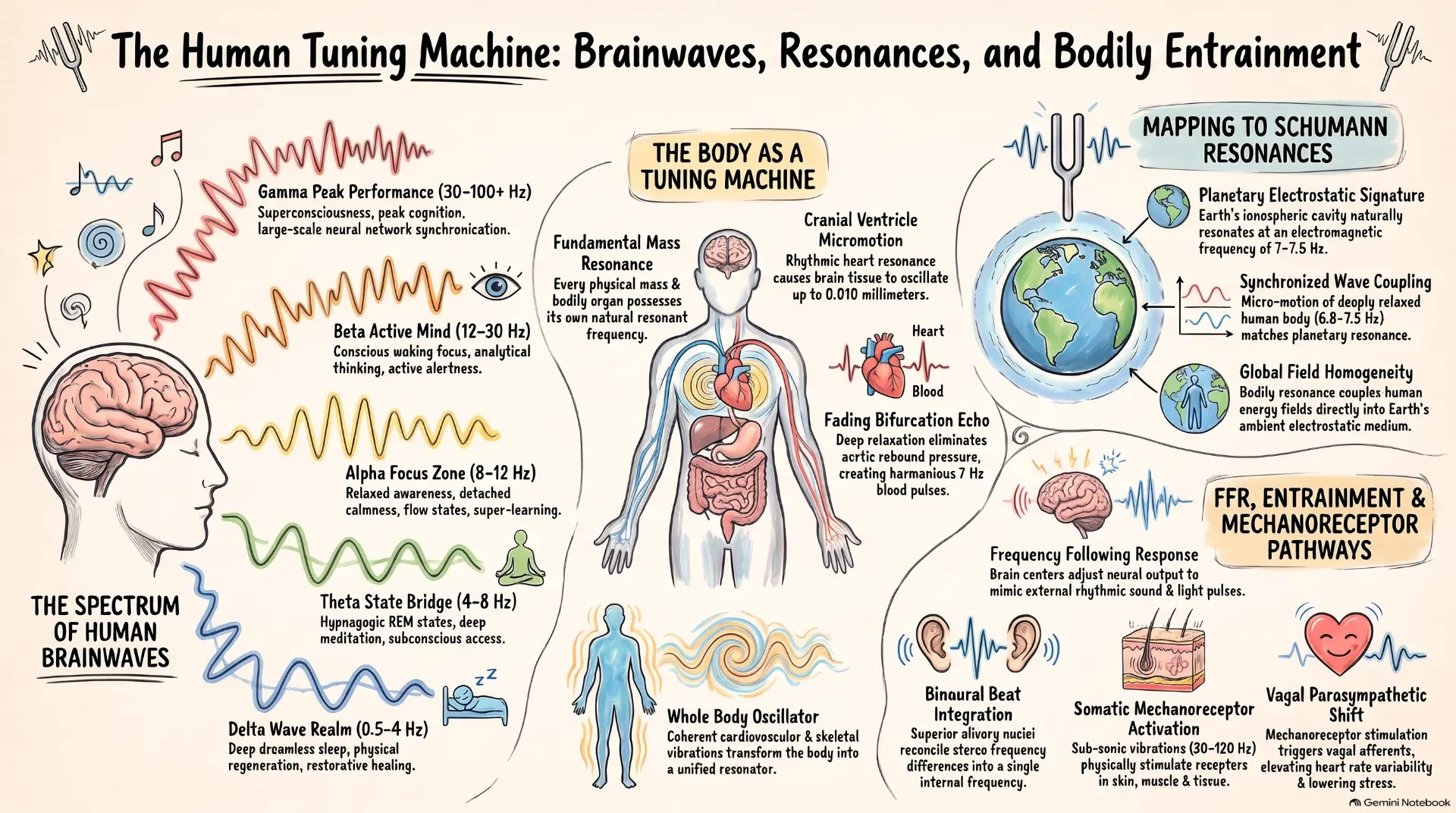
Body and vibration
What does resonance really mean?
Discover why bodies are not tuned to one universal healing frequency.
The key idea
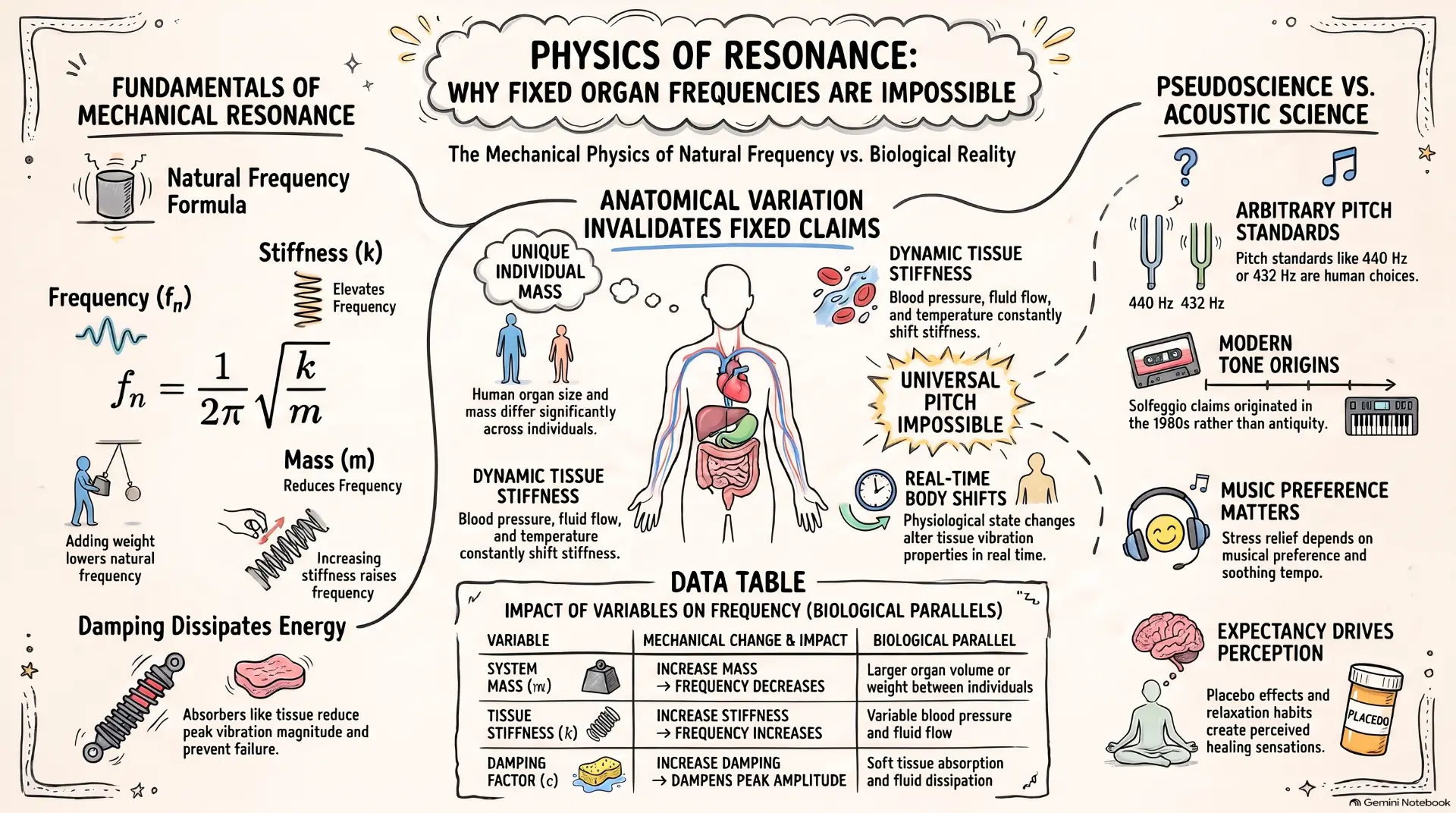
Resonance happens when a force drives a system at its natural frequency. That frequency depends on the system itself.
Follow the process
- 1Force
- 2Mass (m)
- 3Stiffness (k)
- 4f₀ = 1 / 2π × √(k / m)
Why there is no universal organ frequency.
Resonant frequency depends on mass, size, density and stiffness. Every body is different, so no single tone resonates the same organ in every person. If an organ’s mass changes, so does its resonance.
Emotions are not sine waves.
Emotional states have physiological signatures in heart rate variability and EEG. They are complex neurochemical and cognitive states, not acoustic tones measured in Hertz.
The Schumann category error.
The Schumann resonance, about 7.83 Hz, is an electromagnetic resonance between the Earth and the ionosphere, excited by lightning. Music is an acoustic pressure wave. Saying a 432 Hz or 528 Hz track “aligns” with it mixes two kinds of waves and frequencies hundreds of Hertz apart.
We work with how sound actually moves through a body, then measure how that body responds.
Sources and further reading
The Human Tuning Machine