Brain and sound
What are binaural beats?
How two tones create a perceived beat, and what researchers have measured.
The key idea
Neurostimulation and entrainment methods influence nervous-system activity through known neurophysiological pathways.
Follow the process
- 1Left ear 170 Hz
- 2Right ear 174 Hz
- 3Brainstem (superior olivary nuclei)
- 4Perceived 4 Hz beat
- 5Frequency following response
An auditory illusion, first described in 1839.
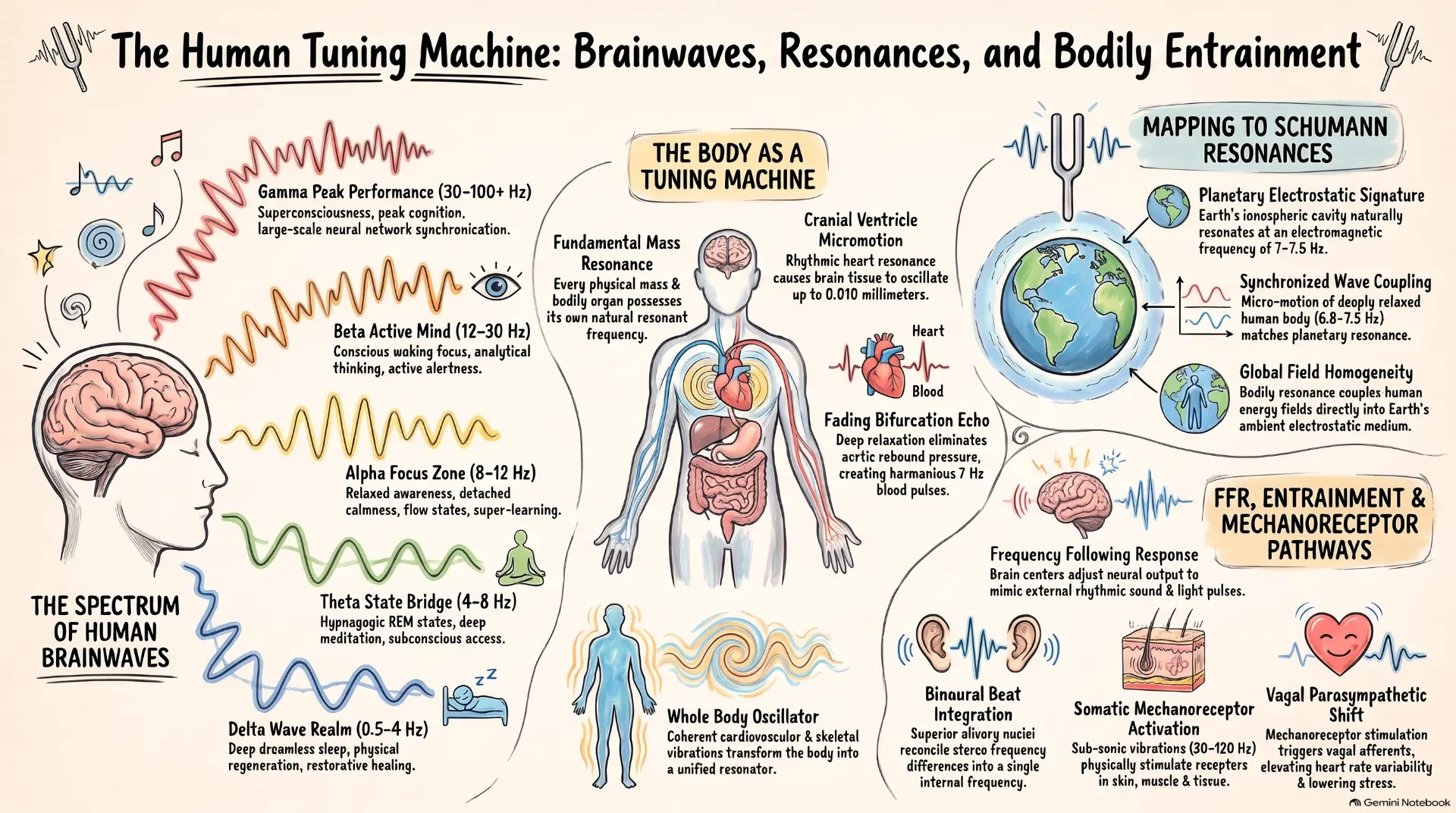
When two slightly different tones reach each ear through stereo headphones, the brainstem detects the phase difference and perceives a third pulsing “beat” at the difference between them.
The frequency following response.
EEG activity can shift toward the rhythm of that internal beat. This is how binaural beats are used to guide the brain toward states such as Alpha (relaxed focus) or Theta (deep meditation and sleep).
Historical context: the Gateway report.
In 1983, U.S. Army Lt. Col. Wayne McDonnell wrote an assessment of the Monroe Institute’s Gateway Process for the CIA. It described Hemi-Sync as producing synchronized activity across both brain hemispheres and drew on Itzhak Bentov’s models of body micro-motion. These are historical hypotheses, not established physiology.
Biotune designs around brainwave states, the part of this research with real measurement behind it.
Sources and further reading
The Human Tuning Machine